01 / PROJECT OPENING
ARCHIVED RESEARCH & DEVELOPMENT · FEBRUARY–MAY 2026
MintyChain began as a wallet-connected publishing service for creating durable public records of digital work. It later evolved into a tenant-scoped accountability system for recording and verifying actions taken by people, software, and machine services.
The two products were different. The underlying concern remained the same: important actions should leave evidence that cannot be quietly rewritten.
Outcome Functioning local beta across two product generations. Core publishing, record-integrity, authority, and verification paths were implemented or locally proven. Public deployment and external integration remained intentionally deferred.
Project chronology
February 4, 2026 Earliest surviving concept material.
February 6, 2026 Development began on the wallet-connected publishing beta.
February 15, 2026 The architectural pivot was formally documented.
February 22, 2026 Development began on the tenant-scoped trust platform.
May 30, 2026 Latest verified repository activity.
Where it started
MintyChain began as one product and ended as another.
That is the part of the project I find most valuable.
I did not begin with a theory about agent governance or organizational provenance. I began with a much simpler question: if information can change, disappear, or be rewritten over time, what would it look like to give someone a durable public record of what they released?
The original idea was a publishing service for people sharing work they had the right to publish—writing, research, books, reports, images, video, audio, datasets, and other digital material.
A person would connect a wallet, select a file, review the storage and publishing cost, approve the transaction, and receive permanent references connecting the work to its publication record.
The idea came from an observation that still matters to me: our understanding of history changes, but the original record should remain available. A journalist’s investigation, an author’s first edition, a research paper, a philosophical argument, or a documented discovery should be traceable to what was actually released at that moment—not only to whatever version survives later.
That became the first MintyChain beta.
02 / THE FIRST GENERATION
Publishing with a durable record.
The first MintyChain was built around a simple sequence:
Choose a file → establish identity → calculate the cost → approve payment → preserve the file and its publication record.
The platform was intended for work that someone had the right to release publicly: articles, books, research, reports, images, audio, video, datasets, presentations, and other original digital material.
The goal was not simply to upload a file. It was to create a durable relationship between the work, the person publishing it, and the moment it entered the public record.
What the beta did
A publisher could connect a Web3 wallet and authenticate through Sign-In with Ethereum. After selecting a file, the system prepared the upload, calculated its expected storage and publishing cost, and generated a USDC-denominated test quote.
The file itself was prepared for durable storage through Arweave. In the beta’s test environment, a Solidity contract on Polygon coordinated the payment path and document reference. The application coordinated the steps between them: file hashing, temporary staging, pricing, approval, contract submission, storage finalization, and the resulting receipt.
This was more than an interface concept. The repository contains the working wallet flow, staged uploads, deterministic file hashing, price calculations, contract approval and write logic, test-token deployment tooling, and the background process needed to complete the publishing lifecycle.
A small transaction with a complete system behind it
The smallest modeled test upload produced a raw cost of approximately one cent, an eight-cent platform margin, and a total price of nine cents.
That amount was not fixed. Larger files increased the storage cost, and the pricing system adjusted the final quote accordingly.
The transaction itself was inexpensive. Making it understandable and dependable required considerably more work.
The system needed to coordinate a browser session, a connected wallet, temporary file storage, an external permanent-storage network, a payment token, a blockchain contract, asynchronous processing, and a final publication receipt. Each part had its own state, failure conditions, and confirmation requirements.
What looked like a small publishing action on the surface was already a distributed workflow underneath.
Why permanence mattered
I was interested in the difference between preserving information and preserving evidence.
A normal file host can keep a document available. A durable publication system can also help establish what was released, when it was released, and which references belonged to that version.
That distinction could matter to an investigative journalist preserving source material, an author recording an edition of a book, a researcher publishing a paper, or anyone whose work might later be altered, removed, disputed, or separated from its original context.
The first MintyChain beta was an attempt to make that kind of record accessible through a familiar publishing experience.

03 / OPERATIONAL PRESSURE
Permanence changes the job.
The hardest part of the original MintyChain was not connecting a wallet, calculating a quote, or writing a document reference to a blockchain.
It was deciding what the platform would be responsible for after someone pressed publish.
When the edge cases became the product
A permanent publishing service needs to consider more than whether a file can be stored successfully.
It has to consider whether the person has the right to publish it, what happens when authorship is disputed, how impersonation is handled, how visitors report harmful or illegal material, who reviews those reports, and what a platform can honestly promise when the underlying record cannot simply be deleted.
I had begun designing around that problem. Executable files were blocked, news publishing was restricted through a wallet allowlist, and the intended moderation model would allow reported material to be removed from the public interface even when its underlying permanent reference continued to exist.
Those were useful boundaries, but they were not a complete safety system.
The repository did not yet contain comprehensive rights verification, automated content review, a mature reporting workflow, staffed moderation, or production-ready legal policies. An interface-level removal process could reduce exposure on the website, but it could not reverse permanent storage elsewhere.
The closer the product came to functioning, the more important that distinction became.
The cost of operating it responsibly
For a public platform, legal review and safety operations could not be postponed until after launch.
The working estimate I reached was approximately $80,000–$90,000 for the legal guidance, policies, protective systems, and operational preparation I believed would be necessary before I could responsibly invite the public to use it.
That estimate did not include the ongoing work of reviewing reports, responding to disputes, maintaining monitoring systems, and making difficult judgment calls about material that might remain permanently accessible outside the product.
For a solo founder, those were not secondary operating expenses. They were becoming the business itself.
The decision
I could have continued building visible features and treated the unresolved responsibilities as future work.
Instead, I stopped the public publishing path before real visitors became the test environment for an unfinished safety model.
That was not the end of MintyChain. It was the first time the project changed because the operating evidence was stronger than the original idea.
The question was no longer whether permanent records were valuable.
The question was where that kind of permanence could be useful without requiring a new public platform to govern everything people might place inside it.
Research trail
The decision was documented across three dated internal artifacts:
February 4, 2026 — Original MVP Build Notes Established the initial low-cost permanent-publishing model using Arweave and Polygon. The document captures the early technical optimism as well as the absence of a developed legal and moderation layer.
February 15, 2026 — System Blueprint v1 Examined liability, privacy, public takedown records, legal intervention, rights claims, and the need to keep policy authority separate from immutable evidence.
February 18, 2026 — MVP Reduction Map Preserved immutable audit and verification while removing raw-payload storage and explicitly reducing legal risk, operational burden, security exposure, and storage liability.
The project’s unfinished Terms and Platform Policy also remain part of the record. Their placeholder state shows that the public operating layer had not reached launch readiness.
External context
- Ar.io’s official content-moderation documentation explains that complete removal from the Arweave network is practically impossible, although individual gateways can block content from being served.
- The U.S. Copyright Office’s Section 512 resources document the notice-and-takedown, designated-agent, and repeat-infringer requirements associated with safe-harbor protection for qualifying online service providers.
04 / THE PIVOT
The useful part was underneath the product.
Stopping the public publishing path did not invalidate the original premise behind MintyChain.
It separated that premise from the product I had built around it.
The first version treated durable evidence as the outcome of publishing something publicly. A person released a piece of work, and the system created references that could help establish what was published, when it was published, and which file belonged to that record.
The publishing service was one expression of the idea.
It was not the idea itself.
What remained
The part worth preserving was not the assumption that every file belonged on a blockchain.
It was the belief that important actions should leave evidence that is difficult to quietly rewrite later.
That evidence should identify who or what performed the action, preserve its position in a sequence, show what it affected, and remain available for later verification.
Once I separated that principle from public file publishing, a different use became visible.
From individual publishing to organizational activity
Software was moving beyond people manually completing every action themselves.
One person could operate multiple tools, automated services, and increasingly capable agents across several internal systems. Those systems could create records, change information, trigger workflows, and affect work belonging to other people.
In that environment, knowing that an action succeeded would not be enough.
An organization might also need to know:
- Which person or organization authorized it?
- Which human was responsible for the machine identity?
- Was that identity active when the action occurred?
- What was it allowed to do?
- Which record or system did it affect?
- What changed?
- Can the sequence be reconstructed later?
- What evidence remains when the system correctly refuses an action?
Those questions carried the original concern with permanence into a more controlled operating environment.
Instead of preserving anything that a member of the public might upload, the system could preserve evidence about specific actions occurring inside an organization that already had its own users, policies, and reasons to maintain accountability.
A narrower responsibility with deeper structure
The product boundary changed.
MintyChain would no longer need to become a public destination responsible for governing every kind of material placed inside it. It could operate beside an organization’s existing software and maintain a separate, reviewable history of the actions that mattered.
The blockchain was no longer required to be the product’s center.
The stronger near-term foundation was an append-only record system: deterministic representations, attributable actors, signed requests, linked event history, database-enforced protections, and verification that could fail when the evidence no longer agreed with itself.
External blockchain anchoring could remain an optional future assurance layer. It did not need to be claimed as part of the implemented core.
This was the real transition:
MintyChain moved from publishing evidence to operational evidence.
The original product asked:
*Can someone later verify what was published?*
The second system asked:
*Can an organization later reconstruct who or what acted, under whose authority, and what happened as a result?*
The product changed because the operating environment changed.
The principle stayed because the underlying problem did not.
05 / THE SECOND SYSTEM
The record became the product.
The second MintyChain was not designed to replace an organization’s existing software.
It was designed to sit beside that software and preserve a reviewable history of the actions that mattered.
It was not a new project-management tool, customer database, or general-purpose agent platform. Its responsibility was narrower: receive an important record, preserve its history, identify the actors involved, and provide evidence that the history still agreed with itself.
A fixed beginning
Every record began with a canonical artifact.
“Canonical” meant that the system converted the original information into one consistent representation before creating its identity. Equivalent information could not produce different results simply because its fields arrived in a different order or its formatting changed.
That representation was processed through SHA-256 to create a unique digital fingerprint.
The system then created a genesis event: the first event in the record’s history and the point against which everything that followed could be checked.
This established a fixed beginning without requiring the original information to be made public or written directly to a blockchain.
Changes were added, not substituted
A conventional application often updates the current state of a record and leaves its previous state behind.
MintyChain took a different approach.
New actions were appended to the record as events. Each event identified its tenant, actor, signing key, position in the sequence, timestamp, correlation reference, previous-event hash, and its own newly calculated hash.
The previous hash connected each event to the one before it.
If an earlier event changed, the connection would no longer produce the expected result. Everything after that point would stop agreeing with the history the system originally recorded.
Database protections also rejected normal update and delete operations against the canonical event tables. The intended path was to add new evidence—not silently revise old evidence until it told a different story.
Verification instead of assumption
The interface could display that a record was valid, but the interface was not the source of that claim.
The verifier reconstructed the record’s history and checked it.
It confirmed that the genesis event existed, every sequence position was accounted for, previous-event links remained intact, event hashes could still be reproduced, the recorded event count matched the actual history, and the latest stored hash agreed with the end of the chain.
It also checked whether the record’s lifecycle transitions were valid. A record could not simply arrive in a state that its preceding events did not support.
When those conditions failed, verification failed with them.
The system was not designed to reinterpret conflicting evidence until it found a passing answer.
What “tamper-evident” meant here
This version did not write every organizational action to a blockchain.
Its implemented integrity came from deterministic records, SHA-256 fingerprints, signed requests, linked event history, database-enforced append-only protections, and verification that could be reproduced from the stored evidence.
That made the history tamper-evident within the system’s implemented trust boundary. It did not make the database magically untouchable, and it would be inaccurate to describe every event as permanently recorded on-chain.
External anchoring remained an optional future assurance layer for organizations that might need an additional form of independent verification.
The distinction mattered because the goal was no longer to make the technology sound permanent.
The goal was to be precise about what the evidence could prove.
What the beta could demonstrate
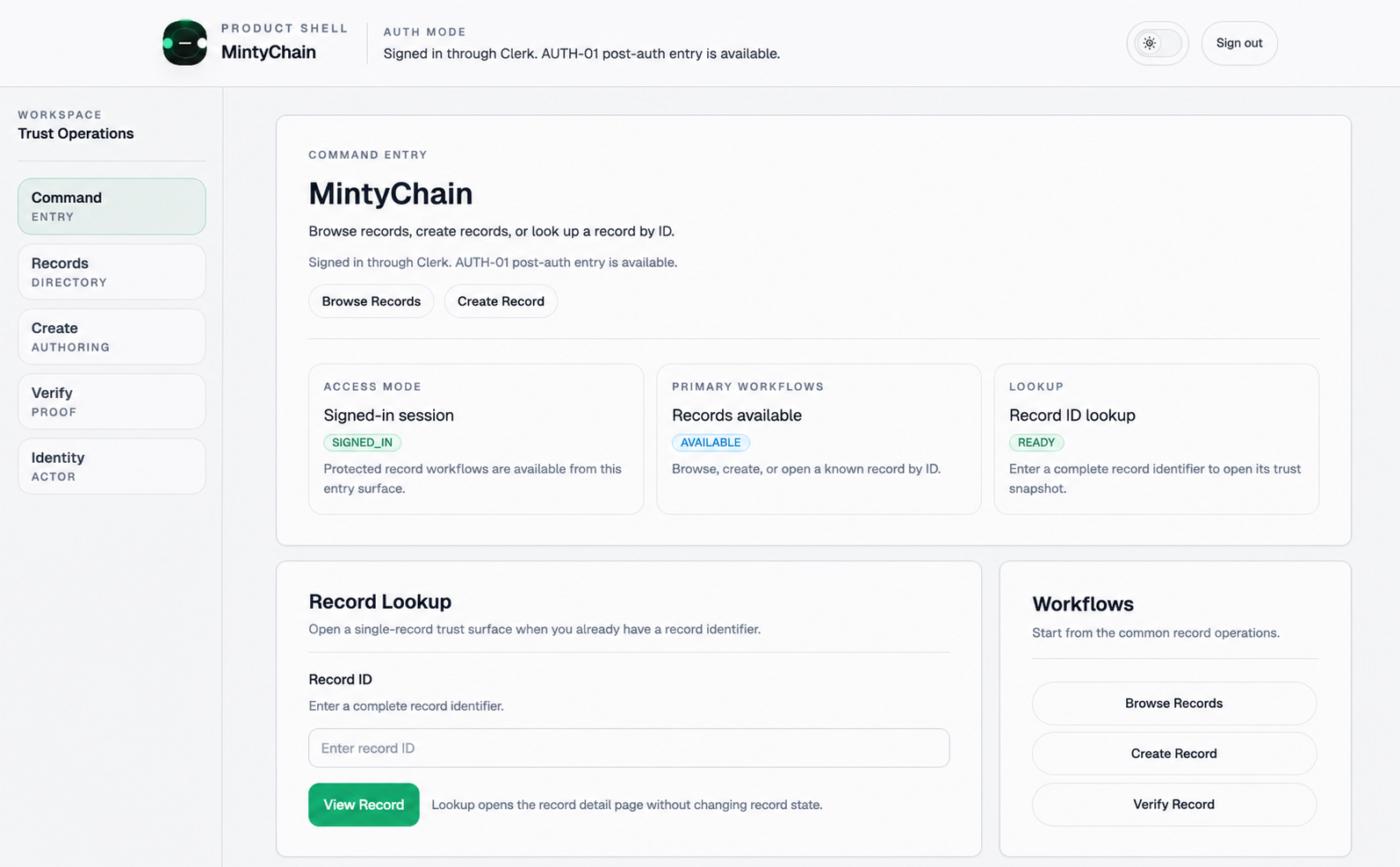
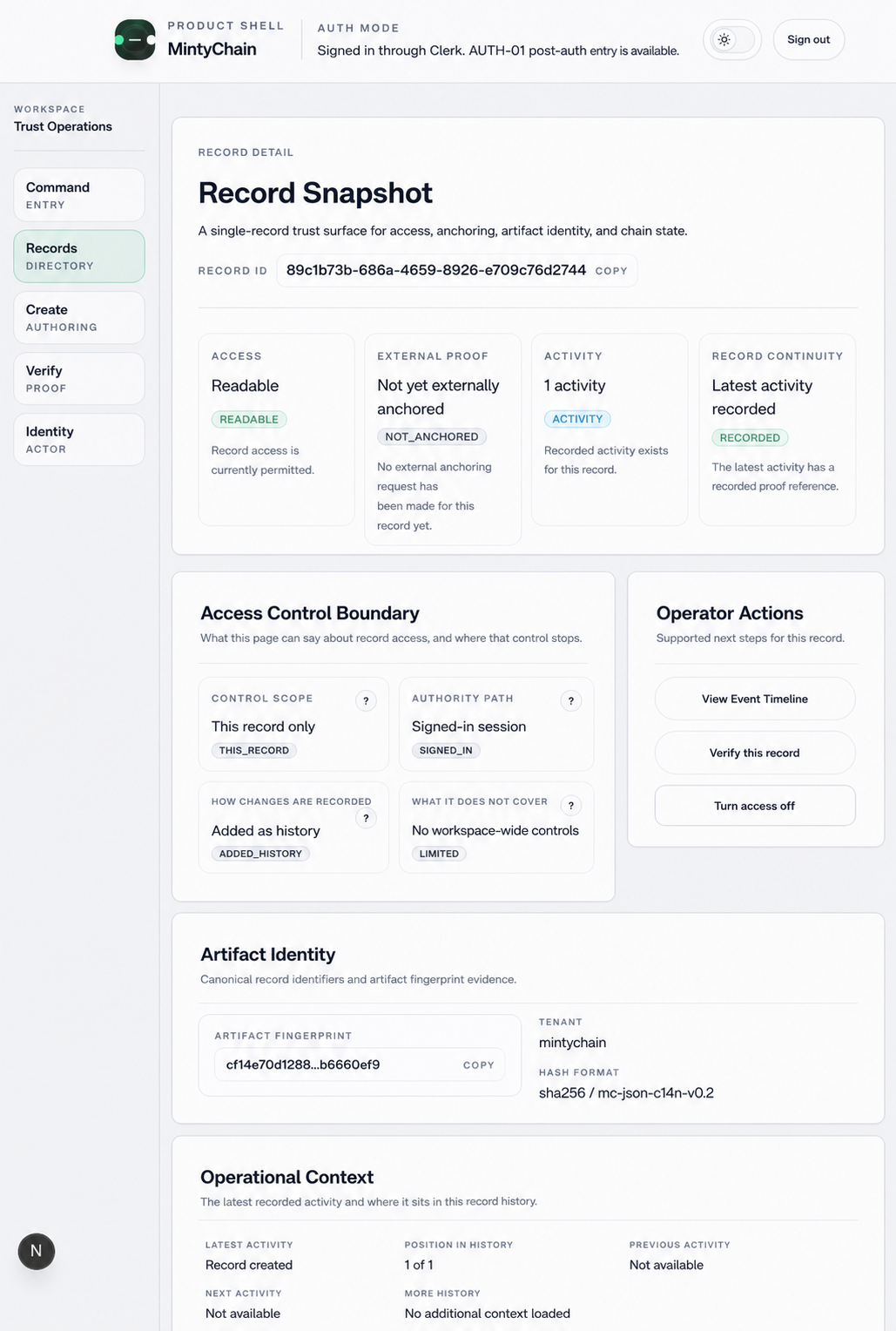
The project reached a functioning local beta with a TypeScript backend, PostgreSQL migrations, signed record routes, a Next.js dashboard, reproducible test fixtures, and a working verification path.
Inside that environment, the system could:
- Create a record from a canonical artifact
- Browse and inspect stored records
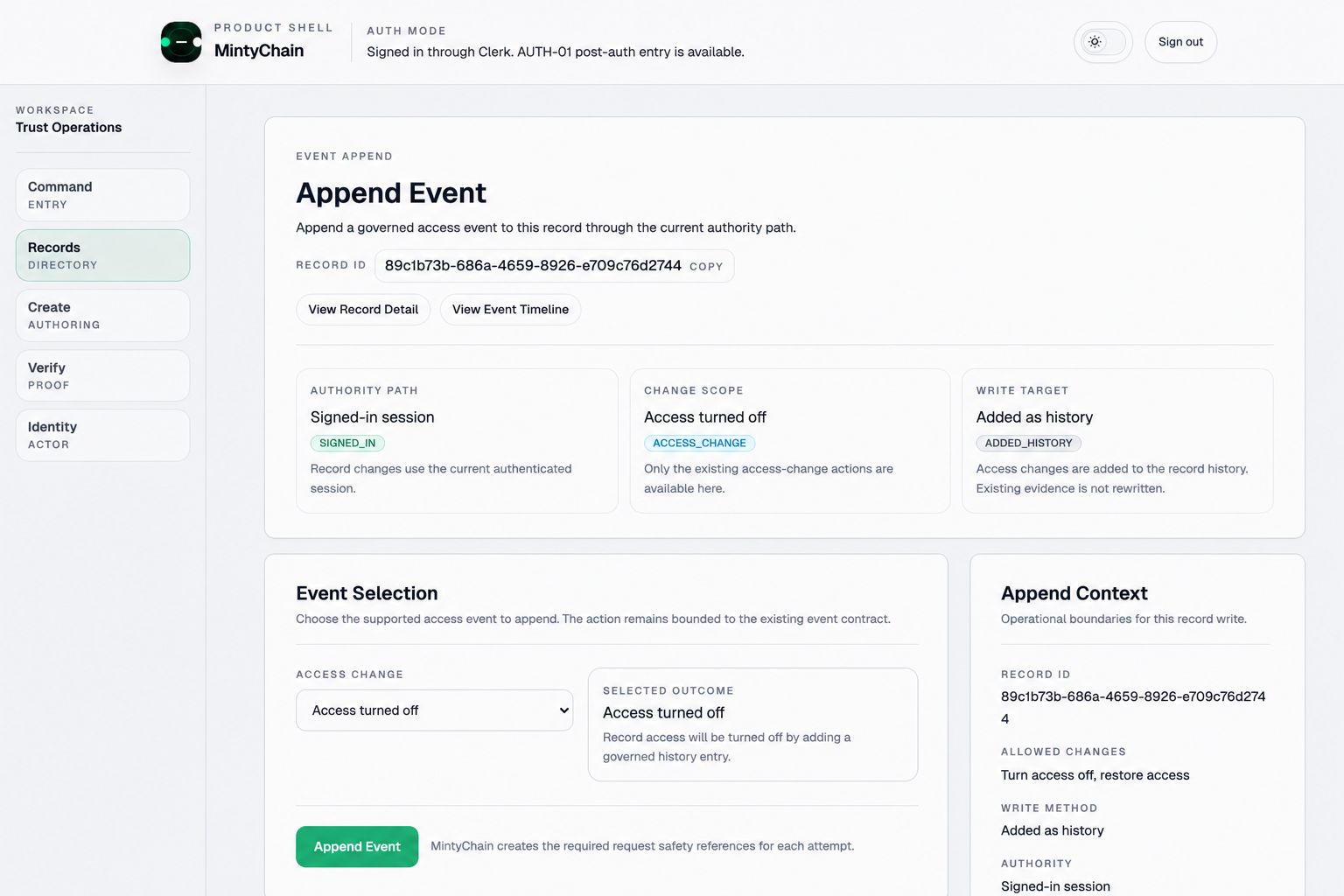
- Append new events without replacing prior history
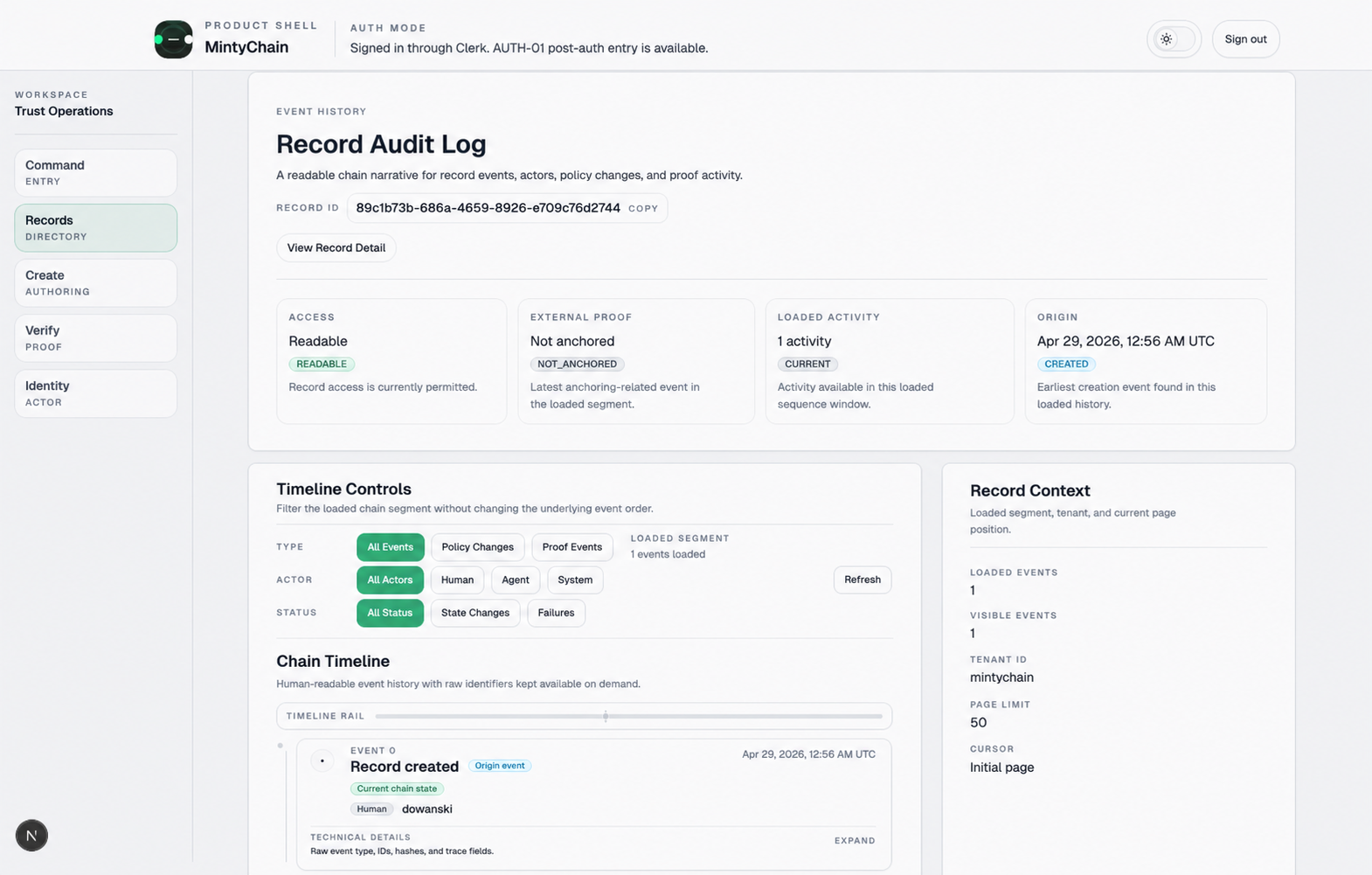
- Display the complete event sequence
- Review changes in access posture
- Generate verification packages
- Recalculate and validate hash-linked history
- Detect integrity failures instead of presenting them as verified
The later development stages also introduced tenant-scoped identity, governed human access, service actors, constrained machine authority, and separate evidence for accepted and denied machine actions.
Those controls deserve their own explanation because they changed the system from a protected record store into the beginning of an accountability model.
The beta was functioning, but it remained local.
It did not include a public SDK, an MCP server, a self-service connector catalog, a live third-party integration, or a production blockchain-anchoring service. Those surfaces remained intentionally deferred while the internal trust model was being proven.
What existed was not the finished operating platform.
It was a working demonstration that a record could carry enough structure to explain where it began, what happened to it, who or what participated, and whether its preserved history could still be trusted.
06 / TENANT, HUMAN, AND MACHINE AUTHORITY
Identity did not equal permission.
Once automated systems enter a workflow, identifying the system making a request is only the beginning.
A credential can help answer:
*Who or what is making this request?*
It does not answer:
*Should it be allowed to perform this particular action, against this particular record, for this organization, right now?*
MintyChain treated those as separate questions.
The organization was the boundary
Each organization existed inside the platform as a tenant.
A tenant was more than an account label. It was the boundary within which identities, credentials, access, records, and authority had to agree.
Human and non-human actors resolved inside that boundary. A credential belonging to one tenant could not quietly become authority inside another. A request could not borrow a valid actor from one organization and apply it to a record owned by someone else.
The system evaluated the tenant declared by the request against the tenant attached to the actor, credential, grant, operation, and target.
If those boundaries did not agree, the request failed.
Humans and service actors
Human actors entered through authenticated sessions and could receive access to specific records.
Protected requests were bound to a canonical representation of the request method, path, body hash, and timestamp. Signing that representation connected the identity to the exact request being made—not merely to an open session somewhere in the application.
Non-human activity used a separate identity type called a service actor.
A service actor could represent an automated service, internal process, or eventually an agent operating through an integration. It belonged to one tenant and carried a reference to the human owner, steward, or internal authority responsible for it.
Its status could be active, paused, or revoked.
This mattered because a machine identity should not continue operating simply because someone still possessed an old credential.
Identity, credentials, and authority remained separate
MintyChain did not treat an API key as permission to do everything.
The service actor established which machine identity was involved.
Its credential established how that identity authenticated. Credentials were versioned and could be paused, rotated, superseded, expired, or revoked without erasing the history of which credential had been used previously.
Authority came from a separate grant.
The grant defined:
- The operation the service could perform
- The specific record or creation context it could affect
- The event types it could append
- The authority that issued the permission
- The purpose for which it was issued
- When the permission expired
- When it needed to be reviewed
The service actor could not issue authority to itself.
The implemented model also prohibited blanket tenant-wide write grants. Permission to work inside an organization did not automatically become permission to change every record the organization owned.
Every condition had to agree
Before a service write could reach the canonical record history, the system evaluated the full authority chain.
The request had to use the approved write route. It needed a request identifier and an idempotency key so that retries could be distinguished from new actions. The actor, credential, and authority grant all needed to remain active.
The tenant boundary had to hold.
The requested operation had to match the granted operation. The target had to match the authorized record or creation context. For an appended event, its type had to appear in the grant’s explicit allowlist.
The system also had to be capable of producing the required audit evidence.
A direct database write, compatibility route, expired credential, overdue grant, incorrect target, unsupported event type, missing identifier, or broken tenant relationship caused the evaluation to fail closed.
Possessing one valid piece of the chain was not enough.
A denied action was still evidence
Successful service actions produced evidence showing the actor, credential, grant, target, request, and authority chain that allowed the write to occur.
Denied attempts were preserved separately.
That separation was important. A failed or unauthorized request should not become part of a tenant’s canonical record history as though it were a valid business event. But it should leave enough evidence to explain what was attempted, which control rejected it, and why.
The system recorded the attempted actor, credential and grant context, target, request identifiers, route, denial reason, tenant-boundary result, and time of evaluation.
Those denial records were append-only as well.
A refusal was not treated as the absence of an event.
It was an operational decision that the system should be able to explain later.
What this stage proved
This work established a functioning local proof of bounded machine authority.
It demonstrated that a managed service actor could append to the canonical history only when its identity, credential, tenant, grant, operation, target, event type, request controls, and audit requirements all passed together.
It did not establish a finished experience for connecting arbitrary AI agents.
There was no public SDK, MCP server, customer-facing connector catalog, or self-service credential portal. A later local integration harness tested how outside context could approach the authority boundary, but it did not pretend that outside context was authority on its own.
The architecture anticipated a future in which humans might operate multiple agents and services across organizational systems.
The implemented proof established the boundary those agents would have to cross responsibly.
This was the point where MintyChain stopped treating a machine as a user holding an API key.
It began treating machine participation as a chain of accountable authority.
07 / DOCUMENTATION-LED ENGINEERING
The build needed a memory of its own.
MintyChain eventually became too complex to hold inside a task list, a single conversation, or my own working memory.
Identity affected access. Access affected records. Records depended on canonical representations. Machine writes depended on credentials, authority, tenant boundaries, approved routes, audit evidence, and the integrity rules beneath the event history.
A decision made in one area could quietly change the meaning of another.
AI made it possible to explore and implement that system at a speed I could not have reached alone. But speed introduced a different risk: every new session could begin with an incomplete interpretation of what the previous session had decided.
I could not allow conversational memory to become the architecture.
So the repository developed a memory of its own.
Documentation became part of the control system
I stopped treating documentation as a description of the work.
It became part of the mechanism that controlled the work.
The repository separated different kinds of truth into different layers:
- Current, repository-validated system state
- Intended system behavior
- Versioned technical contracts
- Active engineering boundaries
- Historical decisions and superseded approaches
- Deferred commitments
- Test and acceptance evidence
- Closure records for completed work
Those layers did not all carry equal authority.
A historical document could explain why something existed without being allowed to override the current implementation. A product plan could define an intended direction without being presented as something already built. A completed checkpoint could preserve evidence without remaining open for casual revision.
The reading order and authority hierarchy mattered because documentation can create drift just as easily as it can prevent it.
More documents do not automatically produce more clarity.
They need structure, status, precedence, and a defined relationship to the software they describe.
Current truth was separated from intended truth
One of the most important distinctions was the difference between what the system was designed to become and what the repository could prove at that moment.
MintyChain’s documentation contained ambitious architecture: external anchoring, customer integrations, agent-facing interfaces, broader verification surfaces, and several possible ledger models.
Those ideas were valuable, but they were not permitted to quietly become implementation claims.
Current-state ledgers recorded what had actually been validated. Versioned contracts described the behavior an implementation needed to follow. Historical specifications remained available for context. Deferred work was preserved explicitly so it did not disappear or slip into active scope without a deliberate decision.
This made statements such as “designed,” “implemented,” “verified locally,” and “deferred” operationally meaningful.
They were not interchangeable status labels.
Work moved through bounded decisions
Large questions were reduced into controlled units of work.
Before implementation began, the relevant part of the repository was inspected and its existing behavior was established. The intended boundary was then defined, including what the work was permitted to change and what had to remain closed.
Implementation followed that boundary.
The resulting changes were reviewed against both the contract and the actual repository. Tests provided proof of behavior. A closure record documented what had been completed, what had been demonstrated, and what remained unresolved.
Only then could a later workstream inherit the result as current truth.
The process was designed to prevent several common failures:
- Coding against an assumption that had never been verified
- Allowing an old plan to override newer repository evidence
- Expanding scope while implementing a smaller change
- Losing an important restriction between AI sessions
- Describing a local proof as a completed product surface
- Declaring a system complete because the visible interface appeared to work
The full internal method became extensive, but its governing principle remained simple:
A claim should inherit authority only after the work beneath it has been examined, implemented, tested, and explicitly closed.
Disagreement triggered investigation
Documentation was not assumed to be correct simply because it existed.
When the written model and the repository disagreed, the AI systems working with me were instructed not to fill the gap with a plausible explanation.
The mismatch became work of its own.
Sometimes the implementation revealed that an older document was stale. Sometimes the code exposed a missing constraint. Sometimes a planned capability had been described too confidently. Sometimes two documents carried incompatible assumptions about the same system boundary.
Those conflicts had to be classified and resolved before development continued.
This gave AI a more disciplined role. It could help inspect, reason, implement, test, and review, but it could not silently invent the project’s current truth.
Proof was preserved, not merely reported
A passing test inside one conversation is easy to lose.
MintyChain recorded important verification as part of the repository’s development history.
At one backend closure checkpoint, the integration suite completed with 116 of 116 tests passing. A later customer-boundary proof was completed through 24 sequential changes and closed with 35 local tests passing.
The numbers were useful, but the greater value was traceability.
The repository recorded which boundary had been tested, which claims the evidence supported, and which conclusions remained outside the proof.
That is why the later integration work could honestly be described as a functioning local harness while SDK, MCP, hosted deployment, asynchronous processing, and real third-party connections remained closed.
The documentation prevented a successful experiment from becoming an exaggerated product claim.
The cost of too much documentation
The method was not perfect.
As MintyChain grew, the documentation system became substantial enough to create its own maintenance burden. Old specifications, new contracts, current checkpoints, active programs, UI doctrine, audits, and deferred work all had to remain distinguishable.
That complexity taught me another lesson:
Documentation is only useful when someone can determine what is current, what is historical, what is binding, and where work should resume.
A large collection of Markdown files is not automatically a knowledge system.
The architecture around those files—their authority, relationships, entry points, and lifecycle—is what makes them operational.
What the method produced
This approach allowed the project to remain reviewable across many AI-assisted development sessions without pretending that either human or machine memory was complete.
The repository could explain:
- Why a workstream was opened
- Which system boundary it was allowed to change
- What the implementation actually did
- Which evidence supported its closure
- What was intentionally excluded
- Where a future session should begin
- Which earlier ideas had been preserved without remaining authoritative
The documentation did not exist to make the repository appear more serious.
It existed so the system could be recovered, questioned, and continued without rebuilding its history from fragments of conversation.
MintyChain was the project where I learned that AI-assisted development needs more than good prompts and capable models.
It needs durable operational context, explicit authority, and a method for turning completed work into trustworthy memory.
08 / THE ARCHIVE DECISION
A working system was not yet a business.
By May 2026, MintyChain had answered several difficult technical questions.
It had demonstrated canonical records, append-only history, deterministic verification, tenant-scoped access, signed requests, governed service identities, bounded machine authority, and evidence for both accepted and denied actions.
What it had not demonstrated was equally important.
It had not proven which specific customer needed the entire system badly enough to adopt a new standalone platform.
Technical proof had moved ahead of market proof.
The category was not empty
The second MintyChain had been designed while agentic software was still forming into a recognizable market category.
As the project developed, that market became easier to see.
My competitive review found direct and adjacent companies working across AI governance, runtime controls, agent identity, observability, provenance, tamper-evident logs, compliance evidence, and tool-call authorization.
The claim that nobody else was working on the problem was no longer credible.
Larger teams already had capital, enterprise positioning, integrations, security resources, and access to customers. Competing as a broad “AI governance platform” would place MintyChain against companies capable of developing several product surfaces at once.
Reducing it to “immutable logs for AI agents” would not solve that problem.
It would make the product easier to describe, but less distinctive.
The missing piece was a first wedge
The architecture still contained useful differences.
MintyChain centered the durable business record rather than the model run. It considered humans, service identities, agents, source systems, authority, and evidence as parts of the same operating history.
It was designed to sit beside a customer’s existing system rather than ask the customer to replace it.
Those qualities could matter.
But they still did not identify the first buyer, the first record, or the first urgent use case.
The strategy work narrowed the possibilities to more specific entry points, including agentic software-change records and external evidence references for high-value operational records.
Those were credible directions.
They were not yet validated markets.
Choosing one would require customer discovery, integration work, security operations, a clear purchasing path, and evidence that the problem was urgent enough to support a company—not merely interesting enough to support more engineering.
Continuing would have changed the bet
The next stage would not have been another contained technical experiment.
It would have required:
- Selecting and validating a narrowly defined buyer
- Integrating with the systems that buyer already used
- Establishing production security and operational controls
- Supporting customer-owned identities and credentials
- Building reliable SDK, MCP, or connector surfaces
- Earning trust around sensitive organizational records
- Creating distribution in a category with funded competitors
- Maintaining the legal and commercial structure required to operate it
For a solo founder, that was a substantially different commitment from proving the architecture.
I could continue adding capabilities, but additional capability would not answer the market question on its own.
At some point, more engineering would have tested my willingness to keep building—not whether the product had earned the right to become a standalone business.
The decision to archive it
I archived MintyChain as an active standalone product after the research period ended in May 2026.
That decision did not mean the software had failed to function.
It meant I was no longer willing to confuse a sophisticated build with a validated company.
The original publishing model had revealed a level of legal and operational responsibility that I could not responsibly absorb. The evolved platform entered a market where the broad category was already attracting specialized and better-resourced teams.
In both generations, the same lesson appeared in a different form:
A product’s operating reality eventually becomes more important than the elegance of its concept.
The responsible decision was to preserve what had been learned, close the unproven expansion paths, and stop presenting continued development as inevitable.
What remains useful
Archiving MintyChain did not erase the architecture.
The work that remains valuable includes:
- Canonical records
- Hash-linked event history
- Deterministic verification
- Tenant and actor boundaries
- Record-scoped access
- Signed request handling
- Service-identity lifecycle
- Bounded authority grants
- Accepted and denied action evidence
- External-reference concepts
- The documentation-led engineering method
- The product interface and verification surfaces
Those components do not require MintyChain to return as a broad standalone platform.
Its strongest future may be as a trust module inside an established system that already has users, workflows, permissions, and an existing reason to preserve accountability.
In that role, MintyChain would not ask an organization to adopt a new operating universe.
It could sit beside work already happening and help make important actions easier to attribute, reconstruct, and verify.
That future remains a strategic possibility, not a shipped integration claim.
What “archived” means
MintyChain is not an active public product.
It is preserved research and development with two functioning beta generations, a documented product pivot, locally verified technical foundations, unfinished outward integrations, and a clearly recorded stopping point.
I do not consider the four months lost.
The project changed how I evaluate permanence, product responsibility, authority, AI-assisted engineering, and the difference between something that can be built and something that should be operated.
It also left behind a system that may become more useful when placed inside the right product rather than forced to become the product itself.
MintyChain is not waiting for another round of features.
It is waiting for a context in which its responsibility, usefulness, and economics finally agree.
Strategy trail
The archive decision is supported by a dated internal strategy package created on May 7, 2026:
Competitive Positioning Brief Mapped direct and adjacent categories, retired unsupported “first” claims, and concluded that MintyChain needed a narrower entry point than generic agent governance, audit trails, or observability.
Pivot Decision Framework Evaluated possible directions against pain urgency, buyer clarity, product specificity, reuse of existing work, solo-founder feasibility, competition, and long-term expansion potential.
Work Reuse Map Recorded which parts of the architecture remained useful under a narrower product direction and explicitly concluded that the system should not be discarded simply because its public market position needed to change.
These documents were strategy records, not marketing material. Their value is that they preserve the reasoning that led to the decision rather than rewriting that reasoning after the project was archived.
09 / CLOSING REFLECTION
What remained was better judgment.
When I look at MintyChain now, I do not see an unfinished company.
I see four months of work that began with a question about permanence and ended with a much deeper understanding of evidence, authority, responsibility, and product judgment.
The first system asked whether digital work could retain a durable public history.
The second asked whether actions performed by humans and machines could remain attributable inside an organization.
Both were expressions of the same instinct: when something important happens, the surrounding evidence should not disappear simply because the software moves on.
Following the problem
MintyChain did not follow the clean sequence usually presented in a product case study.
The first idea worked technically and became less responsible operationally.
The second idea became more defensible architecturally and less convincing as a standalone market position.
Each time, the evidence changed what the project needed to become.
I learned not to protect an original idea merely because I had invested time in it.
Work should be allowed to become more accurate.
Sometimes that means refining it. Sometimes it means narrowing it. Sometimes it means preserving the useful parts and stopping before momentum becomes its own justification.
Building with AI without surrendering judgment
AI expanded what I could inspect, design, implement, document, and test during those four months.
It did not remove the need for direction.
The more capable the tools became, the more important it was to define authority, maintain context, question contradictions, constrain scope, and distinguish a plausible answer from repository evidence.
My role was not to ask a model to “build MintyChain” and accept whatever appeared.
It was to hold the product together across hundreds of connected decisions: deciding what question mattered, what the system could claim, which boundary needed to remain closed, when implementation disagreed with documentation, and when the operating evidence no longer supported continued expansion.
AI increased the reach of the work.
Responsibility for the work remained mine.
More than a technology exercise
The lasting value of MintyChain is not any single framework, database, blockchain, authentication provider, or interface.
It is the synthesis beneath them.
The project required product reasoning, technical architecture, operational risk assessment, documentation design, interface thinking, market research, evidence review, and the willingness to revise a deeply developed system when its assumptions changed.
That combination is what I would carry into another product, team, or problem.
Not the assumption that every idea should become a company.
The ability to examine a complicated system, understand what is actually happening inside it, and make the next decision without losing sight of the people who will eventually have to use, trust, or operate it.
The record stays open
MintyChain remains preserved.
Its architecture may return inside another product whose users, workflows, and operating needs make the trust layer useful. If that context appears, the project has enough technical and documentary history to be understood rather than rediscovered from the beginning.
If it never returns in its original form, the work still matters.
It changed how I build, how I work with AI, how I evaluate risk, and how I decide whether continued development is serving the problem or merely serving the project.
MintyChain is archived.
The judgment it produced is active.